
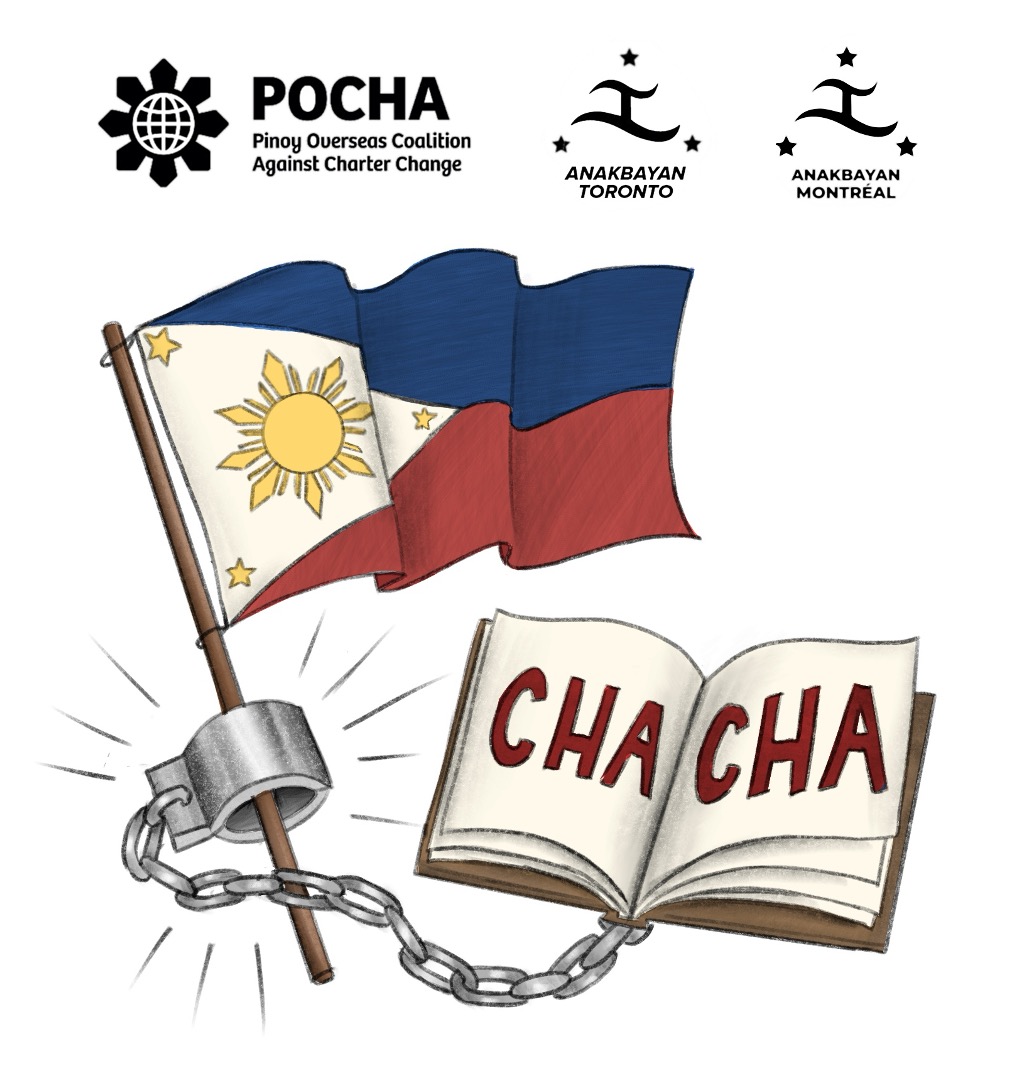
On the 126th anniversary of the Philippines’ so-called “Independence Day” or “Araw ng Kalayaan”, Filipino youth overseas declare that as long as the country operates as a semi-colony of the US, our fight for genuine liberation and sovereignty must continue!
Much like the country itself, the education system in the Philippines is neither truly free nor independent and has experienced corporatization and privatization, exacerbated by foreign ownership. With the proposed charter change in the Philippines, the Marcos Jr. administration is looking to introduce more foreign investment into the country, which means greater foreign control of education. As it stands now, the education system in the Philippines does not serve the interests of Filipinos with students being pushed into becoming both human resources for global capital and canon fodder for imperialist resource wars through education that focuses on the needs of global markets rather than students. This is in addition to growing militarization in the country, as the government attempts to bring back the mandatory Reserve Officers Training Corps (ROTC), effectively continuing to compel the Philippines to participate in the US imperialist agenda and entrapping Filipinos into perennial war.
The worsening economic conditions in the Philippines directly contribute to the learning crisis in the country, according to the January 23, 2024 report entitled “Miseducation: The Failed System of Philippine Education” by EDCOM2 (The Second Congressional Commission on Education), a Philippine commission tasked to undertake a comprehensive national assessment of the country’s education sector. EDCOM 2 reports that the main factors that affect early/basic education and delay child development are chronic malnutrition and stunting. The commission found that one in three Filipino children under five years old is stunted, and the Philippines is among the top 10 countries in the world with the highest number of malnourished and stunted children (World Bank 2021). Although these issues are faced by the majority of Filipinos who belong to the peasant and wage worker classes, the GRP fails at providing support for families and instead prioritizes militarization and the displacement of its people. Despite the primary barrier to education being poverty, the government blames and has even attempted to criminalize parents who are unable to afford school fees rather than investing in true public education.
The education system has also failed to provide support for teachers, who are constantly overworked with reports stating that they spend a minimum of 400 hours annually doing work-related activities outside of their paid working hours. Teachers must perform administrative and ancillary tasks that take away their focus from teaching, effectively eroding instructional time, and often must spend their own already low salaries on classroom supplies. While Marcos, Jr. recently signed the Kabalikat sa Pagtuturo Act (Return to Education Act), which increases the allowance of public teachers to purchase school supplies and attempts to address inflation, it is only a stopgap measure that does not address the root causes of the national economic crisis.
Learners faced inequitable access to higher education, due to high tuition costs with only 17% of the country’s poorest households enrolled in higher education institutions (HEIs) despite EDCOMM 2 recommending that the government “prioritize the poorest of the poor.” The commission states, “Household income is the primary determinant of higher education enrollment, with many students from poor households dropping out early in the education ladder.” Last year, the head of the economic team of the Marcos administration pushed to reassess free college education in state universities and colleges (SUCs), calling the program “inefficient and wasteful,” despite a lack of evidence for that conclusion. Ending the free education program would deprive poor Filipinos from the education that could lift them out of poverty, and the negative effects of that decision would be compounded by the privatization and foreign investment in education proposed by Marcos Jr.’s charter change.

The crisis in education, itself caused by foreign exploitation and corrupt governance, is being used as an excuse to allow further privatization and foreign control. From a report on the corporatization of education in the Philippines, “With the implementation of the new ‘K-12’ system the Department of Education (DepED) plans to grow public-private partnerships and the education services industry in the Philippines so that private enterprise can expand private high school provision and help absorb excess demand.” Instead of providing learning subsidies and funding public education, the government allows education-for-profit schemes such as Ayala’s Affordable Private Education Centers (APEC), in partnership with Pearson, the largest education company in the world with a legacy of undermining locally focused, socially progressive education. Charter change would mean an even higher level of involvement by foreign entities who are drawn by deregulation allowing for larger profits. By not adequately funding education, the government has created a situation where many of these private ventures are seen as preferable to the public school system, laying the groundwork for public acceptance of ever greater disinvestment in public education.
Despite not providing adequate funding for education, the Marcos Jr. administration is eager to throw more money at militarization. As capitalism’s demand for infinite growth comes into increasing conflict with the reality of a finite planet with exhaustible resources, competition between imperialist powers for access to those resources intensifies. The Philippines is caught in the middle as superpowers like the US and China try to secure access to land, fishing grounds, mineral deposits, and other sources of natural wealth. Rather than resist, the Philippines government panders to the imperialists and treats military conflict as inevitable, like Senator Dela Rosa who states, “(Filipinos who are willing to kill invaders and willing to die) in the name of Filipino flag, Filipino people, are more patriotic than those sitting on the sides waiting for what will happen and benefit for the fruits that we harvest after the war,” as a justification for mandatory ROTC. The Philippines is not currently at war with any other country, nor is war a foregone conclusion despite current tensions in the West Philippine Sea. Dela Rosa’s rhetoric is dangerous, and the mandatory ROTC policy aims to indoctrinate Filipino youth to this way of thinking, preemptively manufacturing consent for war which, regardless of outcome, will not advance the interests of the people.
Proponents argue that education focusing on the needs of employers is the best way to prepare students for the real world, but we maintain that a world that cannot meet the needs of the people must be changed, and education should provide the tools to do so. The push for Filipino labour in global markets impedes the growth of the country’s economy and pushes Filipinos into forced migration to other countries. Because capitalism requires significant unemployment to keep wages low, higher paying jobs are concentrated in countries that already have fully developed modern economies. People in underdeveloped countries like the Philippines are encouraged to migrate in search of these jobs, but are usually relegated to low paying, dangerous and dirty jobs.. Mass migration is a band-aid that keeps the Filipino economy from complete collapse and the people from revolting, relieving just enough pressure to allow local institutions to function while diverting the ambitions of the masses towards emigration rather than national development and labor rights.
Despite these challenges, the Philippines is a country with a wealth of natural resources and a rich history of social and cultural progressivism. If those resources are used for the advancement of the whole nation rather than for the enrichment of local and global capitalists, the Philippines has the potential to be a fully independent and self-sufficient country that provides a good life for all Filipinos.
Join us and other overseas Filipinos in a growing network that opposes charter change.
Email us at pocha.canada.info@gmail.com for more information.
 Anakbayan Toronto